
Her left arm hangs off the side of the bed. It is as if her hand is reaching out for them, waiting for them. This is Laurel. For a while, the intruders watch her dream. For a while, they watch her breathe. They know they are saving her. They love her. They love her.
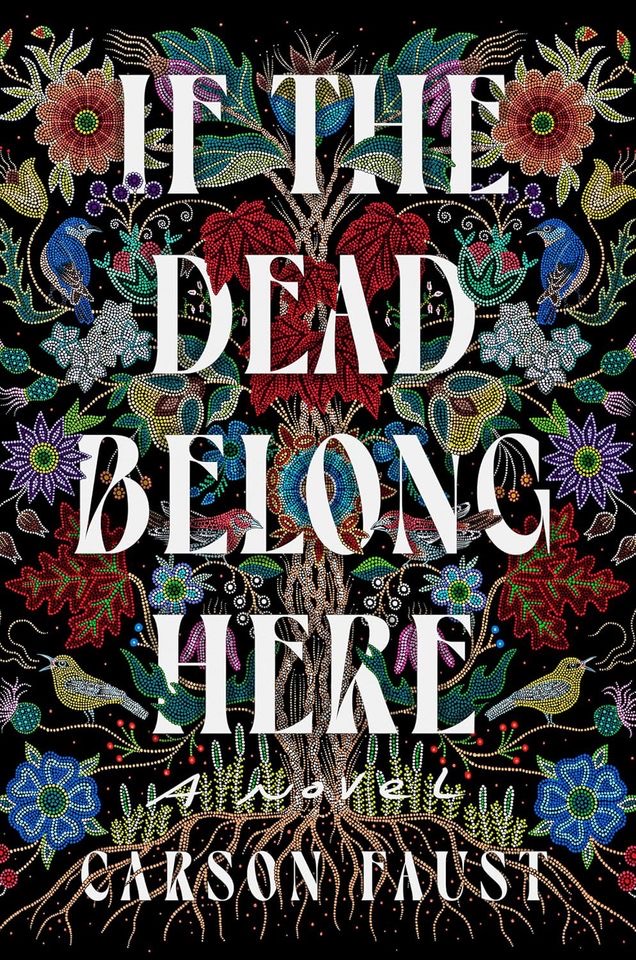
This time last year, I found myself reading an article in Poets & Writers that featured an editor at Viking Books, Ibrahim Ahmad. In a fleeting moment, no more than fifty words, Ahmad spoke about an upcoming project that he was excited about: a Native American southern gothic, If the Dead Belong Here. Immediately, I was hooked. I needed to get my hands on this novel. After reaching out to Viking Book’s publicity team, I got an advanced reader copy. Now, after reading and digesting it, I’m excited to share my thoughts.
If the Dead Belong Here by Carson Faust, published by Viking Books, is a 388 page literary fiction with chapters that rotate between character perspectives and vary in point of view. With long chapters and a heavily character-motivated plot, the story follows a family trying to piece together what happened after their youngest girl goes missing. They’re forced to confront each other, their grief, and the ghosts of the past and present. I will warn you, this book is chilling—I had to stop reading it after dark around page 123.
Is the dense fog from a chill in the air or from the heat of your souls? Is this the ghost of the river, or the ghosts behind your skin stepping out, stepping toward the in-between?
First off, Carson Faust knows how to write. The book often reads like prose, immersing the reader into the atmosphere of the characters through a descriptive narrative style. The tone is consistent throughout, like there’s a dark grey cloud hanging over the world without anyone having to point it out. A particular scene that demonstrated the author’s range of skill was a memorial scene in the middle of the book. The style differs from the rest of the book, jumping from one character to another, creating a muddled sense of intertwined community. Faust has a control over the craft that allows him to make the reader experience the story instead of simply consuming it, which makes the book all the more enjoyable to read.
Faust does an incredible job of depicting the strained relationships between the members of the family and the obligation they feel for each other due to shared blood. An aunt leaves behind her life in South Carolina to help piece her niece back together after her husband leaves. A daughter struggles to have patience with her mother’s alcoholism after the youngest sister’s disappearance. A matriarch passes down her knowledge of healing to her daughters, despite her husband’s disapproval. These women lean on one another as they grieve, as they try to heal, and as they uncover what really happened to the girl who vanished in the middle of the night. They also point fingers, shut one another out, and break each other down. The relationships between them are not simple and contained. They are real, complicated, and heartwrenching.
“They are as alive as you or me, even if we can’t see them, even if they choose not to show themselves. Our teachers, their gift,and the healing we give all sit in that in-between. People like us have to be mindful that we stay where we’re meant to. It’s easier than you think to get tangled in the crossroads.”
A potent theme throughout this novel is ancestry. The book features four generations that experience traumas; some different, and some the same. This becomes a question the main character must grapple with: will healing the trauma of her ancestors bring back her little sister? There is a cyclical motion with every generation of the family, from abusing substances, to surviving domestic abuse, to struggling to be present for family in the face of loss. These relationships portrayed by ancestors and their descendants encourage the reader to consider how generational trauma can create these cycles, whether we’re aware of it or not.
Despite the tragedy of this novel, it is also one of hope and perseverance. While the characters cope differently, they all believe one thing: their girl will come back. They see her shape in the shadows and feel her light travel through their bodies. They hear her voice in the night. They never stop believing in a way to bring her home, and they never stop looking for answers.
If the Dead Belong Here is not petrifying, but it is haunting. It will leave you with ghosts. You’ll find yourself looking over your shoulder for the shadows, watching for the ucv’ske. One thing I loved is that this book does not end in a neat little bow. The ending is not a happy one, but there is closure, and isn’t that all we can ask for sometimes? This is not to say the ending is disappointing, in fact, quite the contrary. It’s unpredictable and disturbing—the perfect ending for this incredible novel.
If the dead could dream alone, most of them would dream peacefully. But when they leave the living, much of the weight they shed is passed to the ones who grieve them. The water tries to find ways to heal. That is why the water is a pathway. The dead can feel the dead. The living can sense the dead. The dead can visit the living.
If the Dead Belong Here was released on October 7th, 2025. You can get your own copy at your local bookstore or at penguinrandomhouse.com/books. Thank you to Penguin Random House for the opportunity to review this book.